Executive Summary and Macroeconomic Market Dynamics
The architectural framework of professional networking is undergoing a seismic structural transformation, transitioning rapidly from analog traditions to highly dynamic, measurable, and integrated digital ecosystems. At the epicenter of this shift is the enterprise adoption of digital business cards, a technology that has evolved far beyond a mere digital replica of contact information. In the contemporary corporate landscape, the digital business card functions as a sophisticated node for identity management, lead capture, and strategic communication. This comprehensive analysis explores the operational necessity of the "Chameleon Executive"—a paradigm wherein modern business leaders dynamically alter their digital professional identity based on the specific audience they are engaging.
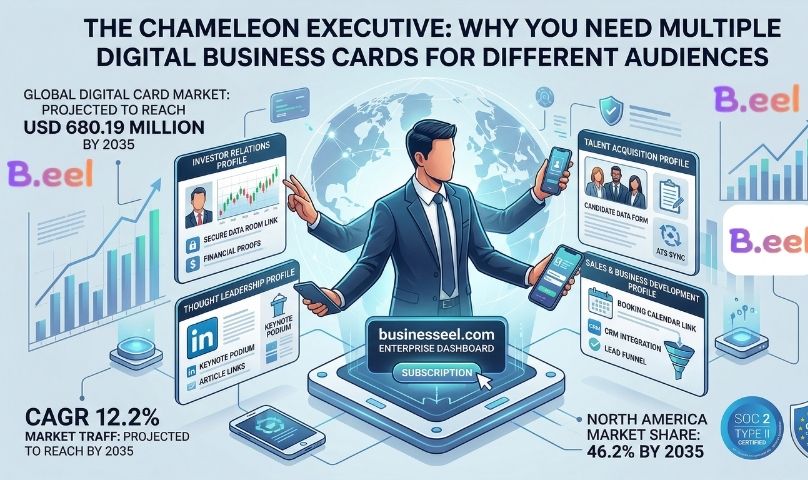
By leveraging advanced platforms like businesseel.com, which offer a unique subscription feature allowing users to create and manage multiple tailored profiles from a single account, executives can execute highly targeted communications that resonate specifically with investors, peers, talent, or prospective clients.
The macroeconomic data surrounding this transition underscores a definitive market consolidation toward digital networking infrastructure. The global digital business card market size was valued at USD 167.5 million in 2023, is projected to reach USD 215.13 million by 2025, and is forecasted to expand to an unprecedented USD 680.19 million by 2035, representing a robust Compound Annual Growth Rate (CAGR) of 12.2% during the forecast period. This growth is not localized but is instead a global phenomenon driven by an aggressive pivot toward contactless networking methodologies in the post-pandemic era and stringent corporate Environmental, Social, and Governance (ESG) mandates driving the shift away from paper-based cards. North America currently commands the market, holding a 35.17% share in 2025, and is expected to maintain its dominance with a projected 46.2% market share by 2035. However, the Asia-Pacific region represents the fastest-accelerating market, characterized by rapid technological adoption and a forecasted 10.43% CAGR through 2031.
The enterprise sector is the primary catalyst for this explosive market expansion. Recent industry analyses indicate that 37% of Fortune 500 companies have committed to fully digitizing their business cards by 2025. Early institutional adopters, including global entities such as American Express Global Business Travel and Volkswagen Financial Services, have demonstrated the operational efficacy of this transition. Within specific industry verticals, the Information Technology and software sectors commanded 29.46% of the market share in 2025, while the healthcare sector is anticipated to grow at a 9.27% CAGR through 2031.
The global market size was valued at USD 167.5 million in 2023 and is projected to reach USD 215.13 million by 2025, eventually growing to USD 680.19 million by 2035, with a compound annual growth rate (CAGR) of 12.2% from 2026 to 2035. North America is expected to emerge as the leading region, holding a market share of 35.17% in 2025 and expanding to 46.2% by 2035. Meanwhile, the Asia-Pacific region is anticipated to grow at a CAGR of 10.43% through 2031. In terms of industry segments, the IT and software sector is projected to dominate with a 29.46% share in 2025. Additionally, the iOS platform is expected to lead among operating systems, capturing a 46.23% market share.
This market trajectory is fundamentally underpinned by the realization that monolithic professional identities are obsolete. In an era where data fidelity and instantaneous communication are paramount, the strategic advantage lies in the ability to partition and customize the professional narrative. The capability to deploy multiple distinct digital profiles from a centralized administrative framework—the core architectural premise of the businesseel.com platform—is no longer a luxury for the C-suite. It is an absolute strategic necessity for maximizing the return on investment (ROI) of every human interaction, allowing leaders to instantly adapt to their environment and seamlessly transition between the roles of visionary, recruiter, and closer.
The Psychological Framework of Executive Identity Segmentation
To understand the necessity of multiple digital profiles and the immense value of the businesseel.com subscription model, one must first examine the foundational psychology of professional interaction and human networking. Networking is fundamentally a complex social behavior that requires significant cognitive processing, often resulting in measurable stress responses for the individuals involved. The inherent anxiety associated with high-stakes professional networking is deeply tied to the burden of managing external perceptions in real-time. By applying established sociological models to digital interactions, the necessity of the "Chameleon Executive" becomes academically and practically undeniable.
Self-Presentation Theory and the Threat of Context Collapse
The theoretical framework for multiple digital profiles is heavily rooted in Erving Goffman’s renowned Self-Presentation Theory, which articulates how individuals actively construct and curate their identities to manage the impressions they impart upon others within specific social environments. In traditional analog networking, an executive utilizes verbal cues, attire, body language, and active listening to shape this narrative and establish authentic rapport. However, the digital era has introduced a phenomenon known as "context collapse," wherein distinct audiences—such as a potential investor, a prospective software engineer, and a peer CEO—are conflated into a single, flattened interactive space.
When an executive is forced to use a singular, static digital business card, they fall victim to this context collapse. A generalized profile forces the executive to compromise their messaging, diluting their identity into a generic baseline that fails to deeply engage any specific demographic. Goffman's theory highlights that the division of the professional self into discrete, manageable facets is not a form of deception, but rather an essential social utility that allows individuals to project the most relevant identity indicators to a targeted audience. Research indicates that professionals frequently struggle to marry the complexities of their offline multidimensional roles within a singular online identity, making the strategic division of the digital self highly relevant and psychologically comforting. The businesseel.com SaaS application directly resolves this psychological tension by offering a unified subscription that allows an executive to maintain multiple compartmentalized identities, effectively professionalizing the personal and ensuring that the right facet of the executive's identity is presented at exactly the right moment.
The Subtlety of Tailored Communication and Tone Modulation
Effective communication is the core competency of successful leadership, extending far beyond the immediate face-to-face interaction to encompass the subtle nuances of tone, phrasing, and visual presentation. In high-level networking, small details drastically alter how a recipient interprets a message and perceives the sender. A singular digital business card inherently lacks the flexibility to modulate tone. For example, a digital profile designed to aggressively capture sales leads may utilize direct language, prominently displayed calendar booking links, and automated follow-up triggers. If this same profile is presented to a peer at an exclusive C-suite advisory council, the aggressive sales tone will likely be interpreted as inappropriate, passive-aggressive, or professionally tone-deaf, mirroring the psychological friction caused by overly aggressive email capitalization or punctuation.
By utilizing the businesseel.com platform, which supports multiple digital profiles under one corporate account, the executive reclaims absolute control over the interaction's tone. The ingratiation strategy—creating a likable, collegial impression—can be hardcoded into a peer-networking profile, emphasizing shared experiences, academic background, and thought leadership. Conversely, an identification strategy aimed at establishing absolute authority and competence can be coded into an investor-facing profile, prioritizing unembellished financial metrics and strict corporate branding. This psychological alignment ensures that the digital asset acts as a harmonious extension of the executive's verbal elevator pitch, drastically reducing the cognitive load required to explain context, and establishing immediate, tailored rapport that traditional, static networking tools simply cannot achieve.
The Chameleon Executive in Action: Audience-Specific Architectures
The architectural strength of an enterprise-grade digital business card solution like businesseel.com lies in its capacity for dynamic contextual adaptation. Different stakeholders require vastly different data sets, security protocols, and engagement pathways. The true "Chameleon Executive" utilizes their centralized subscription to manage highly specialized profiles, ensuring that the digital asset delivered at the point of contact is perfectly calibrated to the recipient's immediate needs, industry vertical, and strategic value.
The Investor Relations (IR) Profile: The Data-Driven Narrative
Investor relations have transitioned into a highly strategic function situated at the absolute center of market interpretation. IR teams and C-suite executives are tasked with translating complex operational performance and risk metrics into a cohesive narrative that the market can inherently trust. In modern financial markets, building this trust requires far more than quarterly earnings calls; it demands continuous, transparent, and highly structured digital engagement where every disclosure reinforces the same strategic story.
When a CEO or Chief Financial Officer (CFO) engages with venture capitalists, private equity partners, or institutional analysts at a roadshow or technology investor conference, a traditional business card is entirely insufficient. An IR-specific digital profile, generated via the businesseel.com platform, functions as a secure, portable data room. This profile must transcend basic contact information to prominently feature critical financial proofs, including links to the latest quarterly investor deck, SEC filings, executive board profiles, and real-time stock details. Savvy investors require proof points that demonstrate productive capital allocation, delivered within a compelling story that connects mathematical performance to corporate strategy and value creation.
Furthermore, the IR profile serves as a critical tracking mechanism. By segmenting the investor network within the platform's integrated Customer Relationship Management (CRM) system, executives can track which analysts or fund managers actually viewed the embedded materials. If a businesseel.com digital card includes a link to an updated technology roadmap, backend analytics will reveal the exact engagement level of a targeted private equity firm, providing the executive with highly actionable intelligence prior to follow-up communications. This profile is entirely distinct from a public-facing card, stripping away marketing language in favor of strict, legally compliant corporate data and direct booking links designed solely for financial stakeholders.
The Public Speaking and Advisory Profile: Cultivating Thought Leadership
High-level executives frequently operate outside of their primary corporate roles, serving on advisory boards, participating in industry panels, or delivering keynote addresses. In these environments, the executive is marketing their intellectual capital, academic insights, and personal brand rather than the immediate operational services of their company. A digital business card deployed from a stage or at an exclusive summit must reflect this distinct persona.
The advisory profile, easily toggled within the businesseel.com app, strips away the transactional elements of a standard business development card. Instead, it prioritizes the individual's thought leadership footprint. Essential components of this profile include a comprehensive biography highlighting prior exits or board seats, direct links to published articles, academic credentials, and prominent integration with the executive's LinkedIn profile. Because speaking engagements often involve interacting with hundreds of attendees simultaneously, the digital card must support high-velocity, low-friction sharing mechanisms, such as a high-resolution QR code displayed on a presentation slide that attendees can scan from a distance without requiring an app installation.
Crucially, this profile leverages seamless integration with Apple Wallet and Google Wallet. When an attendee scans the code, the businesseel.com profile bypasses the need for intermediary applications and saves directly into the mobile operating system's native wallet infrastructure, complete with a professional headshot and a concise value proposition explaining their primary focus, such as "Driving long-term growth and partnerships". This ensures the executive remains an easily accessible, permanent fixture in the recipient's device, fostering long-term relationship building and peer-to-peer social connection rather than immediate transactional pressure.
The Talent Acquisition and Human Resources Profile: High-Velocity Lead Capture
The recruitment of top-tier talent is a highly competitive, fast-paced endeavor. When an executive or human resources leader attends a career fair, university campus, or industry networking event, the primary objective is rapid candidate screening and data ingestion. Traditional paper business cards simply cannot keep pace with the velocity required in modern recruitment. A digital business card engineered for recruitment operates as a localized lead-capture funnel.
In a high-volume setting, the recruitment profile utilizes Near Field Communication (NFC) or dynamic QR codes to instantly trigger a browser-based profile on the candidate's device, requiring zero app installation from the recipient. More importantly, the businesseel.com recruitment profile is equipped with customized data-entry forms designed specifically for candidates. Rather than simply handing over contact details, the card prompts the candidate to input their name, email, and specific role interests in under ten seconds. Advanced platforms allow the recruiter to immediately append contextual tags to the captured lead—such as "5 years Python," "requires remote work," "available in 30 days," or current salary expectations—before syncing the enriched data directly into the enterprise's Applicant Tracking System (ATS) or HR CRM.
This specific profile also dynamically links to current open requisitions on the company's careers portal, allowing the candidate to view relevant opportunities mere seconds after the interaction. By utilizing a distinct recruitment profile through their businesseel.com subscription, the organization entirely eliminates manual administrative data entry, prevents the loss of high-value candidate information, and ensures strict alignment with employer branding guidelines, turning standard career fairs into highly automated candidate generation engines.
The Business Development and Sales Profile: The Conversion Engine
For Chief Revenue Officers (CROs) and enterprise sales executives, the digital business card is a sophisticated weapon for revenue generation. The sales-oriented profile is ruthlessly optimized for lead capture, calendar scheduling, and automated follow-up. Unlike an advisory profile that seeks to educate, the sales profile seeks to convert.
When deployed at a trade show or client site, the sales profile immediately captures the prospect's data and utilizes AI enrichment tools—often achieving up to a 95% enrichment success rate—to append missing professional details by cross-referencing public databases and LinkedIn profiles. This enriched data is instantaneously routed into complex CRM ecosystems such as Salesforce, HubSpot, or Zoho. The sales profile integrates directly with scheduling tools, allowing a prospect to book a discovery call while still standing in the convention hall.
The analytics attached to the sales profile within the businesseel.com platform are foundational to modern business development. Sales executives leverage these insights to track exactly when a prospect interacts with the digital card, what specific marketing links were clicked, and how often the card was viewed. This real-time telemetry allows for highly personalized and impeccably timed follow-up communications, guiding the prospect through the sales funnel with unprecedented precision. Studies demonstrate that companies utilizing dedicated lead capture software experience an average 30% increase in overall lead generation and a 25% increase in sales-qualified leads, underscoring the vital nature of deploying a purpose-built sales profile rather than a generic contact card.
Enterprise Architecture: Centralized Management of Fragmented Identities
The operational reality of deploying the "Chameleon Executive" strategy across a global enterprise introduces significant administrative complexity. If a corporation employs five hundred executives, and each executive utilizes the businesseel.com subscription to maintain three distinct digital profiles (e.g., Sales, IR, and Advisory), the organization is suddenly tasked with governing one thousand five hundred unique digital endpoints. The viability of this strategy relies entirely on the sophistication of the SaaS platform's centralized management dashboard.
Mitigating Decentralized Fragmentation
When individual departments within a business attempt to manage their own digital networking solutions independently, the organization suffers from decentralized intelligence. Decentralized approaches lead to fragmented brand identities, isolated data silos, and a complete inability to aggregate performance metrics across the enterprise. Each group funds its own effort and chooses its own tools, resulting in an operational paradox where the pursuit of efficiency generates profound inefficiency. A centralized business intelligence approach, facilitated by an enterprise-grade dashboard, unifies this data, extracting insights from every single digital interaction and storing it in a secure, single location.
A centralized dashboard addresses these challenges by offering absolute real-time visibility and comprehensive brand governance. Marketing and IT administrators can enforce strict corporate brand guidelines across the entire businesseel.com deployment—locking approved color palettes, typographical hierarchies, and official logos—ensuring that every single profile, regardless of its specific target audience, maintains the integrity of the corporate identity. This level of control is essential; without it, executives may inadvertently deploy rogue profiles that utilize outdated branding or convey unauthorized messaging, thereby damaging the organization's professional reputation in front of high-value stakeholders.
Automated Provisioning and Operational Efficiency
The centralized architecture drastically improves workplace efficiency by automating routine administrative burdens. Modern enterprise digital card platforms, exemplifying the core utility of businesseel.com, integrate directly with Human Resources Information Systems (HRIS) and Active Directory infrastructures. Through this integration, the provisioning of digital business cards becomes entirely automated. When a new executive is onboarded into the corporate system, the centralized dashboard automatically generates their predefined suite of digital profiles, populating them with accurate titles, contact numbers, and reporting structures.
Conversely, when an individual departs the organization, the system automatically revokes access and deactivates the associated profiles simultaneously, ensuring that former employees cannot continue to represent the enterprise or access captured lead data. This automated provisioning saves marketing and IT departments hundreds of hours of manual configuration, representing up to a 30% time savings on repetitive administrative tasks. Furthermore, the centralized reporting mechanics aggregate the performance data of every profile, allowing corporate leadership to make data-driven decisions regarding which networking events, trade shows, or personnel are generating the highest verifiable ROI. By consolidating effort and simplifying operations, the centralized dashboard reduces the overall Total Cost of Ownership (TCO) through consistency, repeatability, and control at scale.
Security, Compliance, and Data Governance in Executive Networking
As digital business cards transition from consumer novelties to critical enterprise infrastructure, they become subject to the highest standards of international data security and regulatory compliance. The information exchanged via these digital assets—including direct executive contact details, proprietary investor decks, and candidate data—is highly sensitive. Platforms failing to meet stringent security frameworks expose the enterprise to catastrophic data breaches and severe regulatory penalties. The businesseel.com platform differentiates itself by strictly adhering to these global mandates, ensuring that multi-audience profiling does not compromise institutional security.
The Imperative of SOC 2 Type II Certification
For any enterprise, particularly those operating within the financial services, legal, or healthcare sectors, SOC 2 Type II certification is a non-negotiable prerequisite. This certification is not a self-assessment; it requires rigorous, independent third-party auditing of a platform's data handling protocols, internal access controls, and incident response methodologies over an extended period. SOC 2 Type II ensures that the digital card provider utilizes end-to-end data encryption, both in transit and at rest, mitigating the risk of data interception during NFC or QR code data transfers.
Global Privacy Regulations and Authentication
In addition to SOC 2, global enterprises demand absolute adherence to the General Data Protection Regulation (GDPR). While SOC 2 addresses the physical and architectural security of the data, GDPR governs the fundamental data rights of the individuals involved, dictating strict protocols for consent, data portability, and the right to erasure. A dual-certified platform ensures that contact data captured during an interaction in Europe is processed with the same legal rigor as data captured in North America. A platform that has SOC 2 but ignores GDPR is only half-compliant, exposing the enterprise to immense liability.
Furthermore, enterprise platforms secure these thousands of profiles through enforced Single Sign-On (SSO) and Multi-Factor Authentication (MFA) protocols. Enforced SSO allows corporate security teams to control access to the digital card ecosystem using their existing centralized identity providers (such as Okta or Microsoft Entra).
This eliminates the vulnerabilities associated with individual password management and ensures that the digital networking infrastructure is protected behind the enterprise's primary cryptographic firewall. For investment bankers and healthcare professionals handling regulated information, this granular administrative control is vital to maintaining overall institutional compliance while successfully deploying their specialized networking profiles. Additional standards, such as the Payment Card Industry Data Security Standard (PCI DSS), become relevant if the digital ecosystem expands to facilitate secure payment transactions directly from the networking profile, requiring robust vulnerability management and strong information security policies.
Strategic Deployment within High-Stakes Networking Enclaves
The necessity of the multi-profile "Chameleon Executive" strategy is most acutely demonstrated within exclusive, high-stakes networking environments. C-level executives frequently participate in private peer groups, mastermind summits, and exclusive syndicates such as the C-Suite Network, Chief, the Senior Executive Network, and Gartner's Evanta communities.
These enclaves are designed as safe, highly confidential spaces where executives go beyond traditional networking to engage in candid peer-to-peer validation, strategy testing, and collaborative problem-solving. According to recent governance surveys, 88% of executives cite exclusive opportunities to connect with peers as the most valuable aspect of community membership. In these zero-trust, high-value environments, participants are hypersensitive to self-promotion and aggressive sales tactics. Presenting a standard, transactional business card within a trusted C-Suite Council immediately violates the implicit social contract of the group, eroding trust and signaling a lack of situational awareness.
Within these exclusive circles, the executive must leverage the businesseel.com architecture to deploy a meticulously crafted peer-advisory profile. This specific digital asset must emphasize shared macro-level challenges, strategic insights, and mutual corporate governance interests rather than product features or service pricing. By rapidly adapting their digital identity to match the exclusivity and tone of the environment, the executive cultivates authentic, mutually beneficial relationships that yield massive downstream value. Historical data from these networks indicates that peer-facilitated introductions and shared intelligence regularly save organizations millions of dollars in operational costs—such as navigating complex captive insurance models or renegotiating bank lines of credit based on peer intelligence—and yield highly lucrative strategic partnerships. The multi-profile digital business card is the precise technological key required to gracefully navigate and capitalize upon these elite social ecosystems without alienating the target demographic.
Measurable ROI and Strategic Implementation Outcomes
The transition from analog to digital networking requires a profound shift in how organizations evaluate the efficacy of professional interactions. Traditional paper business cards are fundamentally an unquantifiable expense. The data highlights a stark reality: 88% of paper business cards are discarded by the recipient within a single week. Organizations distribute thousands of these cards annually, hoping for engagement, yet possess zero visibility into their actual impact. The enterprise adoption of multi-profile digital cards transforms networking from an opaque sunk cost into a highly measurable, data-driven strategic initiative.
Eradicating Financial Inefficiencies and Environmental Waste
The immediate financial return on deploying digital business cards is substantial. Enterprises report an average 90% reduction in printing and distribution costs immediately following the transition. For large organizations that historically procured heavy cardstock, custom embossing, and international shipping for thousands of employees, the capital expenditure savings are massive. Beyond the financial implications, the elimination of physical resource consumption aligns perfectly with corporate sustainability priorities, providing a measurable reduction in the company's carbon footprint and fulfilling vital ESG reporting requirements. Sustainability is not merely a public relations talking point; it is a measurable corporate priority for businesses expanding into 2026 and beyond.
Engagement Tracking and Superior Data Retention
The fundamental value of the digital platform is the conversion of an interaction into actionable data. Unlike a paper card that disappears into a desk drawer, the digital card tracks every digital touchpoint. Analytical dashboards reveal precisely how many times a card was viewed, which specific links were engaged with, and the geographical location of the interaction.
Moreover, the digital format drastically improves the retention of the executive's identity. Recipients of digital business cards are 55% more likely to retain the contact information compared to traditional methods. Because the digital card seamlessly injects the executive's data directly into the recipient's mobile address book or digital wallet, the friction of manual data entry is entirely bypassed. This ensures that when a recruiter follows up, or a sales executive initiates a discovery call, the recipient already has the contact fully mapped in their communication ecosystem, establishing immediate familiarity.
Seamless Integration into Existing Tech Stacks
To realize this ROI, the digital business card cannot exist in isolation; it must function as a synchronized component within a robust tech stack. By utilizing deep Application Programming Interfaces (APIs) and native integrations, modern digital cards push captured data directly into downstream systems. When an executive scans a badge or a physical business card at a conference using their platform's integrated Optical Character Recognition (OCR) and AI enrichment tools, the prospect's data is verified and instantly populated within the corporate CRM. This holistic integration ensures that contact details are always accurate, and follow-up workflows are triggered automatically, guaranteeing that no high-value relationship is lost in the post-event administrative shuffle. Case studies across varied industries—from sustainable mining infrastructure to complex B2B software environments—demonstrate that moving from a feature-based networking approach to a value-driven, structured digital rollout drastically improves consistency in the sales process and elevates the holistic customer experience.
Strategic Synthesis and Concluding Imperatives
The era of the singular, analog professional identity has permanently concluded. The modern commercial environment demands agility, deep contextual relevance, and absolute data fidelity in every interaction. The transition toward enterprise digital business cards is not merely a digitization of paper; it represents a fundamental upgrade to the infrastructure of human capital connectivity.
The strategy of the "Chameleon Executive"—empowered by centralized SaaS platforms such as businesseel.com that facilitate the creation and governance of multiple, highly targeted digital profiles from a single account—provides organizations with a critical competitive advantage. By enabling executives to dynamically pivot their projected identity to precisely match the psychological and strategic needs of investors, peers, recruits, or clients, the enterprise maximizes the ROI of its most valuable asset: human relationships.
To capitalize on this technological shift, organizations must mandate the integration of dual-certified (SOC 2 Type II and GDPR) digital networking platforms that offer robust centralized BI dashboards, seamless CRM and HRIS synchronizations, and advanced lead-capture capabilities. The implementation of this architecture will eradicate the financial waste of analog printing, secure sensitive corporate data, and provide unprecedented analytical visibility into the efficacy of the enterprise's global networking efforts. Organizations that fail to adopt this multi-profile digital strategy will inevitably suffer from context collapse, degraded lead generation, and an inability to resonate in increasingly specialized, high-stakes commercial environments. Embracing the specialized subscription features of a centralized digital ecosystem is the definitive step toward modernizing the executive presence and securing long-term institutional growth.